
Kubernetes blast radius analysis
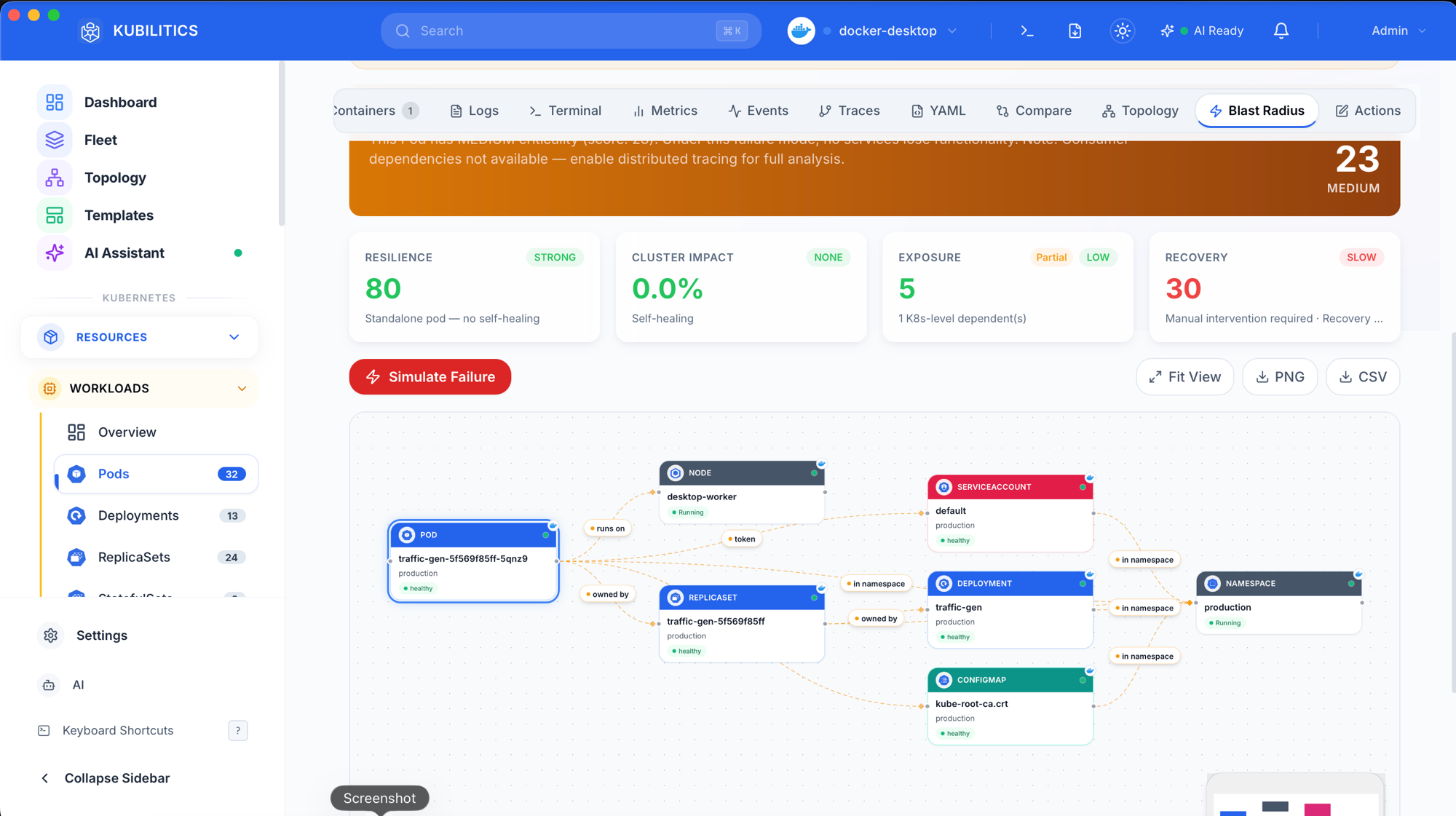
Kubernetes blast radius is the set of workloads, services and namespaces affected when one resource fails or changes. Kubilitics computes it from your live cluster’s dependency graph, scores how critical the resource is, and lets you simulate its failure before you touch it.
The problem
kubectl apply tells you nothing about what else depends on the object you are changing. A ConfigMap can be mounted by pods in several deployments, a Service can front a single replica, and a node can host the only copy of something important. During an incident, engineers rebuild those chains by hand.
What Kubilitics shows for any resource
- Cascade: every resource, service and namespace that depends on it, directly or transitively.
- Criticality score (0–100): low, medium, high or critical, with the sub-scores shown so you can see why.
- Resilience: replica count, HPA and PodDisruptionBudget posture of the workload behind it. For a Service, that is the workload it actually selects.
- Simulate Failure: highlights what goes down if the resource is removed.
- Recovery and exposure: whether a controller will bring it back and with how much replica headroom, and whether it is internet-facing through an Ingress (plus traffic weight when trace data exists).
How the score works
Kubilitics uses the method behind FMEA (IEC 60812): severity, occurrence and detection are multiplied into a Risk Priority Number. Here, occurrence is derived from resilience, detection from recovery, and severity from impact and exposure. The three are combined with a geometric mean so one catastrophic dimension cannot be hidden by decent scores in the others. A resource with no dependents scores zero, because nothing can break.
Where the graph comes from
The dependency graph is built from live informers, not a one-time scan. Edges include owner references, Service selectors, ConfigMap and Secret usage, PVC, PV and StorageClass bindings, NetworkPolicy selectors, and Pod-to-Node scheduling, so a node drain shows exactly which pods would be lost.
Related: single point of failure detection, namespace risk ranking, topology views. Download Kubilitics and point it at a cluster.
Frequently asked questions
What is blast radius in Kubernetes?
Blast radius is the set of resources, services and namespaces that would be affected if a given Kubernetes resource fails or is changed. Kubilitics computes it from the live dependency graph of your cluster.
How does Kubilitics calculate a criticality score?
Four sub-scores (resilience, exposure, recovery and impact) are combined with an FMEA-style Risk Priority Number using a geometric mean. The result is a 0–100 criticality score mapped to low, medium, high or critical.
Can I simulate a failure before it happens?
Yes. The blast radius view includes a Simulate Failure mode that shows which dependents would be taken down if the selected resource disappeared.
Which relationships does the dependency graph include?
Owner references, Service selectors, ConfigMap, Secret and PersistentVolumeClaim usage, PersistentVolume and StorageClass bindings, NetworkPolicy selectors and Pod-to-Node scheduling.
Does it change anything in my cluster?
No. Blast radius analysis is read-only. Kubilitics reads cluster state through the Kubernetes API and never applies changes as part of analysis.